The United Kingdom has long been one of the world’s most attractive destinations for high-net-worth individuals seeking opportunities for business expansion, quality education, and an enviable lifestyle. From London’s position as a global financial powerhouse to the UK’s robust legal system and world-class universities, it’s no surprise that entrepreneurs and investors continue to look to Britain for long-term residency and citizenship opportunities.
For decades, the allure of the British passport—with its visa-free access to over 180 countries and territories—has made UK citizenship a highly sought-after asset for the internationally mobile elite. Whether you’re looking to establish a business footprint in Europe, diversify your family’s residence options, or simply enjoy the cultural richness of life in the UK, understanding the current immigration landscape is absolutely crucial.
1.2 Navigating the Post-Golden Visa Landscape
However, if you’ve been researching UK investment visas recently, you may have encountered confusing or outdated information. The truth is, the UK immigration system underwent a seismic shift in February 2022 when the government closed the Tier 1 Investor visa—commonly known as the “Golden Visa”—to new applicants. This route, which allowed wealthy individuals to essentially buy residency by parking millions in UK government bonds, is no longer available.
⚠️ Important Reality Check:
The traditional “cash-for-visa” pathway is gone. The UK now requires active entrepreneurship and genuine business contribution, not passive investment. This guide will show you the new, legitimate routes available in 2026 and beyond.
Today’s landscape favors genuine entrepreneurs who want to build innovative businesses in the UK. The flagship route is now the Innovator Founder visa, which replaced older schemes and emphasizes active involvement, creativity, and economic contribution. This shift reflects the government’s desire to attract real talent and job creators rather than purely wealth-based immigration.
In this comprehensive guide, we’ll walk you through the current options for investors and entrepreneurs, the eligibility criteria you need to meet, and—most importantly—the step-by-step timeline from visa approval all the way to British citizenship. Let’s dive in.
2. The End of an Era: The Tier 1 Investor Visa

2.1 Why the Golden Visa Was Closed
On February 17, 2022, the UK Home Office officially closed the Tier 1 Investor visa route to new applicants. This decision came after years of mounting pressure from security agencies, anti-corruption watchdogs, and media investigations that exposed how the program had been exploited for money laundering purposes.
The Tier 1 Investor visa allowed individuals to invest a minimum of £2 million (with faster routes at £5 million and £10 million) primarily in UK government bonds or share capital in British companies. The problem? This was largely passive investment that didn’t require the visa holder to actively contribute to the UK economy. Critics argued it had become a “cash-for-passport” scheme that allowed questionable wealth—particularly from politically exposed persons and those with opaque funding sources—to enter the country with minimal scrutiny.
Following Russia’s invasion of Ukraine and heightened concerns about illicit finance, the UK government decided to permanently shut down this route. The closure was both sudden and final, catching many prospective applicants off-guard. There is currently no direct replacement for this passive investment visa, and rumors of a new “strategic investment” visa remain unconfirmed as of 2026.
2.2 Options for Existing Visa Holders
If you already hold a Tier 1 Investor visa, don’t panic—you’re protected under transitional arrangements. Here’s what you need to know:
- Extension Applications: Existing Tier 1 Investor visa holders can apply for extensions until February 17, 2026.
- Settlement (ILR) Applications: You can apply for Indefinite Leave to Remain until February 17, 2028, provided you meet the continuous residence and investment requirements.
- Accelerated Routes Still Valid: The fast-track settlement options (2 years for £10 million investment, 3 years for £5 million) remain available for those who qualified under the old rules.
If you’re an existing holder, it’s critical to work with an immigration solicitor to ensure you meet all ongoing requirements, particularly the investment maintenance rules and the continuous residence test. But for everyone else reading this who doesn’t already have a Tier 1 visa, we need to explore the new pathways.
3. The New Gold Standard: The Innovator Founder Visa
3.1 Understanding the Eligibility Criteria
The Innovator Founder visa is now the primary route for experienced business people who want to establish or run an innovative business in the UK. Unlike the old Tier 1 Investor visa, this isn’t about how much money you have—it’s about the quality and viability of your business idea.
Here are the core eligibility requirements:
- Innovative Business Idea: Your business plan must be genuinely innovative, meaning it offers something new to the market—not just a copy of an existing business model.
- Viability: The business must be realistic and achievable based on your skills, experience, and available resources. It can’t just be a “pie in the sky” concept.
- Scalability: The business should have potential for growth and job creation in the UK market. Think expansion potential, not just a lifestyle business.
- Active Day-to-Day Role: You must be actively involved in running the business. This isn’t a passive investment—you’re expected to work in the company.
Importantly, there is no longer a fixed minimum investment amount (the previous Innovator visa required £50,000). However, you must demonstrate that you have sufficient funds to establish and run the business until it becomes profitable. In practice, most successful applicants invest between £50,000 and £200,000, depending on the business sector.
3.2 The Role of Endorsing Bodies
Here’s the crucial gatekeeping step: before you can even apply for the Innovator Founder visa, you must secure an endorsement from an approved UK endorsing body. These are organizations authorized by the Home Office to assess whether your business idea meets the innovation, viability, and scalability criteria.
Approved endorsing bodies include:
- UK Endorsing Services
- Envestors Limited
- The Global Entrepreneurs Programme
- Innovator International
The endorsement process involves submitting a detailed business plan, financial projections, and evidence of your business experience. The endorsing body will interview you (often via video call) to assess your understanding of the UK market and your commitment to the venture. This is a rigorous process—approximately 30-40% of initial applications are rejected at the endorsement stage.
💡 Pro Tip: Work with a specialized immigration advisor or business consultant to prepare your endorsement application. The quality of your business plan and financial model can make or break your chances. Many endorsing bodies also offer pre-application consultations for a fee.
3.3 A Faster Route to Settlement
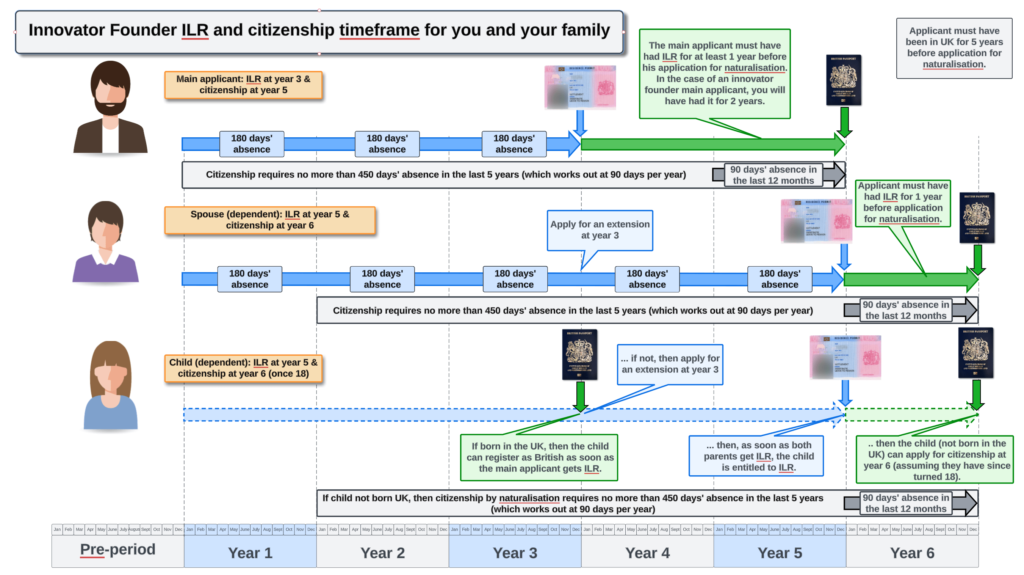
One of the most attractive features of the Innovator Founder visa is the accelerated path to permanent residency. Unlike most other UK work visas, which require five years of continuous residence before you can apply for Indefinite Leave to Remain (ILR), the Innovator Founder route allows settlement after just three years.
To qualify for ILR at the three-year mark, you must meet at least two of the following criteria:
- At least £50,000 has been invested in the business and actively spent furthering the business plan
- The number of your business’s customers has at least doubled within the most recent three years and is higher than the mean number of customers for other UK businesses offering comparable services
- Your business has engaged in significant research and development activity and has applied for intellectual property protection in the UK
- Your business has generated a minimum annual gross revenue of £1 million in the last full year covered by its accounts
- Your business has created the equivalent of at least 10 full-time jobs for settled workers
This faster settlement pathway is a significant advantage for ambitious entrepreneurs who can demonstrate genuine business success in the UK.
4. Alternative Pathways for Entrepreneurs and Talent

4.1 The Global Talent Visa
If you’re a leader or emerging leader in the fields of academia, research, arts and culture, or digital technology, the Global Talent visa might be your best option. This route doesn’t require any investment at all—instead, it’s based purely on your exceptional talent or promise.
To qualify, you need endorsement from one of the designated UK bodies in your field, such as Tech Nation (for digital technology), the Royal Society (for science and medicine), or the Arts Council (for arts and culture). The endorsement process evaluates your achievements, recognition, and impact in your industry.
The Global Talent visa offers incredible flexibility: you can work for any employer, be self-employed, or start your own business. Settlement is possible after three years (or sometimes five, depending on your field), and there’s no minimum salary requirement. It’s an excellent option for tech founders, researchers, or creative professionals.
4.2 The Self-Sponsorship Route (Skilled Worker)
This is a more complex but viable strategy for investors who want to establish a UK presence. The concept is straightforward: you set up a UK company, obtain a sponsor license for that company, and then sponsor yourself for a Skilled Worker visa.
Here’s how it works in practice:
- Establish a legitimate UK company (usually a limited company)
- Apply for a Skilled Worker sponsor license for that company
- Create a genuine job role that meets the skill and salary requirements (minimum salary is typically £38,700 or the “going rate” for the occupation, whichever is higher)
- Issue yourself a Certificate of Sponsorship
- Apply for a Skilled Worker visa
The Home Office scrutinizes self-sponsorship applications carefully to ensure they’re not merely “shell companies” created solely for immigration purposes. You’ll need to demonstrate that the business is genuine, trading actively, and that your role is necessary and appropriately skilled. This typically requires professional legal guidance to structure correctly.
The advantage? Once you have the Skilled Worker visa, you can apply for ILR after five years of continuous residence. The disadvantage? Significant compliance burden, salary requirements, and the need to maintain sponsor license obligations.
4.3 Debunking the Property Myth
Let’s address a persistent misconception that continues to circulate, particularly in overseas markets: buying property in the UK does NOT grant you a visa or any right to reside in the country.
🏠 The Property Myth:
Purchasing a £2 million mansion in Kensington will not give you residency rights. The UK has never had a “golden visa by property purchase” program (unlike countries such as Portugal or Greece). Residential property investment is completely separate from immigration status.
You are absolutely welcome to purchase UK property as a foreign national (there are no restrictions), and it can be a sound investment. However, it won’t help your immigration case unless the property is being used as part of a legitimate business venture that qualifies under one of the entrepreneurial visa routes described above. Don’t be misled by agents or advisors who suggest otherwise.
5. From Visa to Passport: The Timeline to Citizenship

Once you’ve secured your visa—whether it’s the Innovator Founder, Global Talent, or another route—the journey to British citizenship follows a well-defined path. Let’s break down each stage.
5.1 Securing Indefinite Leave to Remain (ILR)
Indefinite Leave to Remain is the UK’s version of permanent residency. It grants you the right to live and work in the UK without time restrictions, though it’s not quite the same as citizenship (you still can’t vote in general elections or hold a British passport).
The timeline to ILR eligibility depends on your visa route:
3 Years
Innovator Founder Visa
3-5 Years
Global Talent Visa
5 Years
Skilled Worker Visa
To qualify for ILR, you must meet the following requirements:
- Continuous Residence: You must not have been absent from the UK for more than 180 days in any 12-month period during your qualifying residence. This is strictly enforced—even exceeding the limit by a few days can disqualify you.
- Life in the UK Test: You must pass this citizenship test, which covers British values, history, traditions, and everyday life. It’s a 24-question multiple-choice exam, and you need to score at least 75%.
- English Language Requirement: You must prove English proficiency at B1 level (intermediate) or higher, unless you’re exempt (e.g., nationals of majority English-speaking countries or those over 65).
- Good Character: The Home Office will assess whether you’re of “good character,” which includes checking your criminal record, immigration compliance history, and financial conduct (unpaid taxes, bankruptcy, etc.).
The application fee for ILR is substantial—currently around £2,885 per person—and processing times can range from several weeks to several months depending on complexity.
5.2 The Final Step: Naturalisation
After you’ve held ILR for at least 12 months, you become eligible to apply for British citizenship through naturalisation. (The exception: if you’re married to a British citizen, you can apply for citizenship immediately upon receiving ILR.)
The naturalisation requirements include:
- Residency Requirement: You must have been in the UK for at least five years before the date of your application, with no more than 450 days of absence during that five-year period. Additionally, you cannot have been absent for more than 90 days in the 12 months immediately before your application.
- ILR Status: You must have held ILR (or permanent residence under EU Settlement Scheme) for at least 12 months.
- Good Character: This is assessed even more strictly than for ILR. Any criminal convictions, immigration violations, or financial irregularities can be disqualifying.
- Future Intentions: You must intend to continue living in the UK or working abroad for the UK government, a British company, or an international organization of which the UK is a member.
The naturalisation application fee is approximately £1,630 (subject to change), and the process typically takes 4-6 months. If approved, you’ll be invited to attend a citizenship ceremony where you’ll take an oath of allegiance to the Crown and receive your certificate of British citizenship. Only then can you apply for your first British passport.
Year 0-3 (or 0-5)
Visa Stage: Maintain continuous residence, comply with visa conditions, build your business or career, pass Life in the UK Test.
Year 3 (or 5)
ILR Application: Apply for Indefinite Leave to Remain, demonstrate compliance with residency and character requirements.
Year 4 (or 6)
Naturalisation: After holding ILR for 12 months, apply for British citizenship, attend ceremony, receive passport.
In total, the fastest possible route from initial visa to British passport is approximately four years (for Innovator Founders or certain Global Talent visa holders), while the standard route takes around six years. This is significantly faster than many other developed countries’ citizenship pathways.
6. Conclusion

6.1 Summary of the Investment Landscape
The UK’s shift from passive investment to active entrepreneurship represents a fundamental change in immigration philosophy. The days of simply writing a check to secure residency are over. Today’s successful applicants are genuine business builders, innovative thinkers, and talented professionals who are committed to contributing to the UK economy.
While this new landscape is undoubtedly more challenging than the old “Golden Visa” era, it also creates opportunities for those with real business acumen and innovative ideas. The Innovator Founder visa, in particular, offers a compelling proposition: a faster route to settlement, the freedom to build your own venture, and a pathway to one of the world’s most valuable passports.
For those who don’t fit the entrepreneurial mold, alternatives like the Global Talent visa or the self-sponsorship route provide viable pathways, each with its own advantages and challenges. The key is to honestly assess your own situation, skills, and long-term goals, then choose the route that aligns best with your profile.
6.2 The Importance of Professional Guidance
UK immigration law is notoriously complex, and the stakes are high. A single mistake in your application—whether it’s failing to maintain proper records, miscalculating your absences, or submitting inadequate business documentation—can result in refusal, wasted fees, and potentially even a ban on future applications.
⚖️ Legal Recommendation: Given the complexity and strict enforcement of UK immigration rules, we strongly advise consulting with a regulated immigration solicitor or advisor before proceeding with any application. Look for practitioners registered with the Office of the Immigration Services Commissioner (OISC) or solicitors regulated by the Solicitors Regulation Authority (SRA).
Professional immigration advisors can help you:
- Assess which visa route is most suitable for your circumstances
- Prepare a compelling business plan for endorsement
- Navigate the endorsement process with approved bodies
- Ensure strict compliance with continuous residence requirements
- Prepare thorough and accurate visa, ILR, and citizenship applications
Yes, professional advice comes at a cost—typically ranging from £3,000 to £10,000+ depending on the complexity of your case. But when you consider that the total cost of the visa-to-citizenship journey (including Home Office fees, endorsement fees, and the opportunity cost of your time) can easily exceed £50,000, investing in expert guidance is simply prudent risk management.
The United Kingdom remains one of the world’s premier destinations for ambitious entrepreneurs and talented professionals. The pathway to British citizenship may be more rigorous than it once was, but for those with genuine innovation, business skill, and commitment, the opportunity is very much alive. With careful planning, professional guidance, and determination, your journey from visa holder to British citizen can become a reality within just a few years.
Good luck on your journey—and welcome to the UK!
References & Resources
This guide is based on official UK government guidance, immigration law, and expert analysis current as of February 2026. Immigration rules are subject to change, so always verify current requirements before making decisions.